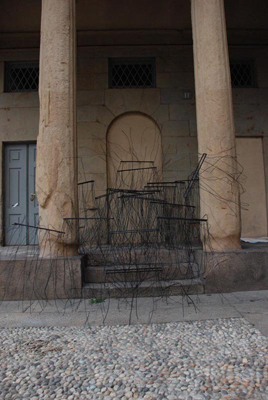
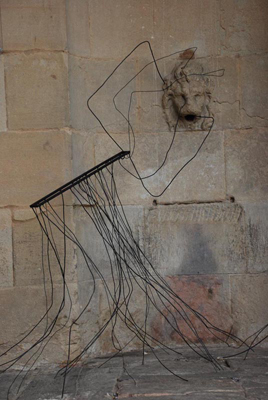
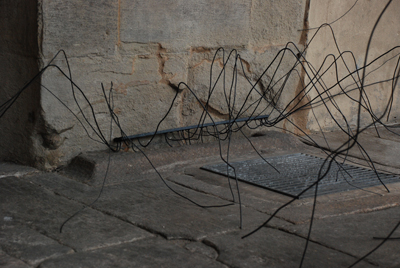
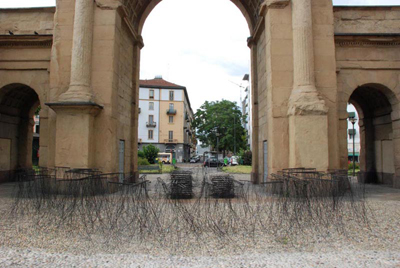
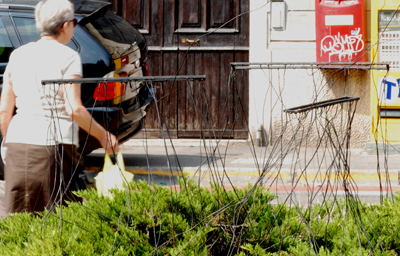
Invading Landscape to Invade Society. The occasion came when a space, a square, in the centre of Milan, came available for an installation. Not only a square, but the space where one of the old entrances in medieval Milan's walls still resides. A starting point was clear since the beginning. The “Caselli daziari di Porta Nuova”, litteraly “customs of the new entrance, of the new door to the city”, was going to be a stage and not simply a frame as I saw it used in other past installation by other artist. I was going to be a stage for what it represented and for what it was made for. Even though as the name says, was the last built, in defensive walls yet useless, it represented the political and economical border of the city. The place for the control to take place, the place where the goods and the people where or where not allowed in the city. The place that as modern customs are, is the practicality of a thoughts that is rooted in the fear of who is different, in the fear that something different can enter our reality and change it in an unpredictable way. Something or somebody that can change us, change our reality, change our relationships, change our landscape and our position in it. Scenery that was and is this way. A man draws a line on the ground and claims to be his everything on his side and guards with the sword his line drawn in dust. At this time Italy patrols its sea borders from immigrants from North Africa, builds invisible doors and draws lines in the sea. A xenophobic party, “Lega Nord”, litteraly “Northern League”, is part of the italian government and is more than 20 years now that is promoting a secession of the rich north of Italy from the poor south, while being at the same time against immigration. So is not just a matter of skin, but also of wealth, and Milan is historically run by this party and its right-wing allies. So the occasion was to good to be lost. The city was right, the place was right, the moment was right. So I imagined the horde. I imagined a horde of poor people trying and actually succeeding to enter the city, from one of its doors, one of its old customs. But what if they were just men, what if they where not the barbaric horde that the government controlled news tries everyday to depict. What if they where not going to set the city on fire, burning and looting. But just looking for a place to stay, a landscape to share with other people, that was not that of war, famine, diseases or simple poorness. From this assumptions came “Invasione”, “Invasion”. I imagined a sort of clumsy horde, harmless but numerous, entering the city with childish curiosity, exploring a new space that had opened, to try to understand where they had landed. So they sieged the door with the innocence of somebody who is trying to understand just by touching, to feel the consistency, the reality of what is before his eyes. The installations therefore had a minimal plot, that consisted in three acts. So the first act was the mentioned harmless coming, an exploration, a reconnaissance. Then the first feeling of discomfort, for the city being nothing but welcoming and therefore the horde compacts, looks for the presence of the other companions on their side, for the comfort that that can give while facing an hostile situation. So the second act had the horde deployed in a thick row, but not as an army, more like a pack of preys closed in an angle by the predators. And the predators attac, they try to push back the horde and some lives are taken. So the third act has the remaining individuals grouped around the stashed bodies of the slayed ones, in a sort of act of chanting and despairing.
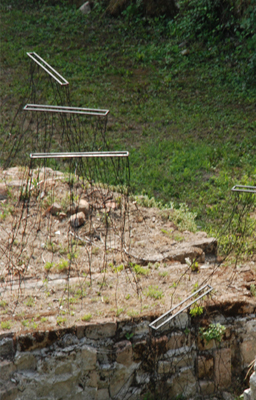
Because of the ruinous conclusion of the “Invasion”, one month later, in a similar context I staged the sequel, imagining the horde scattered and fleeing the city gathering back in the outskirts of Milan, in the provincial city of Lodi. The installation this time was called “Rendezvous” as the horde was looking for a safe place do gather and lick its wounds. The sculpture were in part hidden in the trees that surround the almost destroyed castle of Lodi, still a defensive structure, but some were scouting the area, still trying to interact with the locals. But none of the attempts of integration really worked out so the army decided to scatter and to adopt a different survival technique.
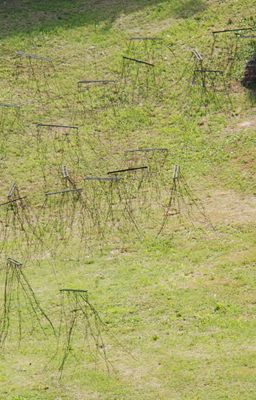
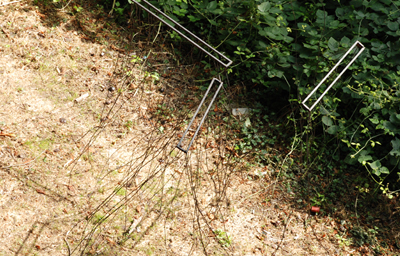
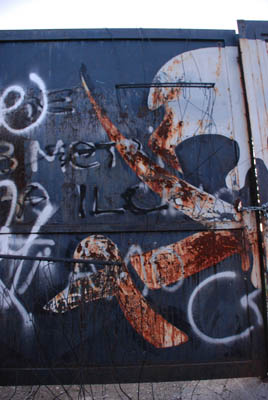
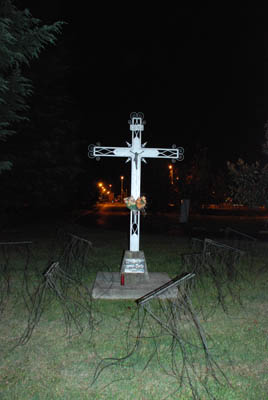
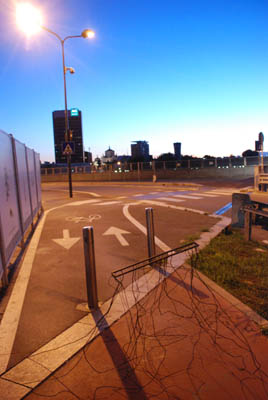
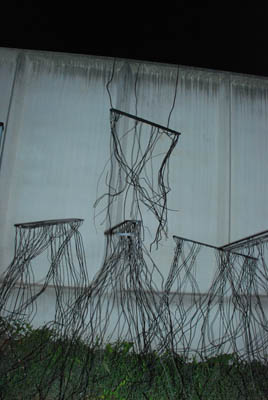
“Guerrilla” is the final chapter of the story which have seen the horde dispersed in the landscape, singularly or in small groups. Raiding, hiding, saboting, because there's no place for a difference in the contemporary Italian landscape.
The pictures are therefore all that remains of the installation.
|