|
"Silent", 2010, 14.30minutes
|
|
"10.000+", 2010, 4 minutes
|
|
"Exile", 2010, 27 minutes
|
|
"unnamed, unpossessed", 2010, 14 minutes
|
|
Portraying Landscape. Landscape is where you finish. Landscape is where everything that is in the landscape clashes, happens, lives, dies and communicates. Despite men's efforts to shape landscape, to possess it, to humanize it, to make of it an extension of its will and a place for its need to be fulfilled, landscape maintains its own autonomy, just slightly interfered by the humans efforts. It has to be said that the struggle is unfair and that the effort required is beyond the human scale. But men seem not to care and continue to build their ant-hill over a gigantic rock lost in the darkest sky. And as men build and pave, the rock stretches swallowing the manmade, flooding and storming it. None the less men rebuilds again, bigger and stronger. But on every scale the clash in on and weeds grow in the cracks, slowly turning concrete to the dust and dirt which it is, with the tiny fingers of their roots. Landscape is a war map of unrecordable complexity in which everything is an army of its own and belongs to many armies.
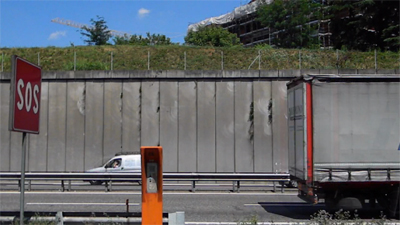
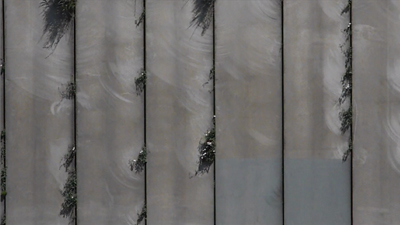
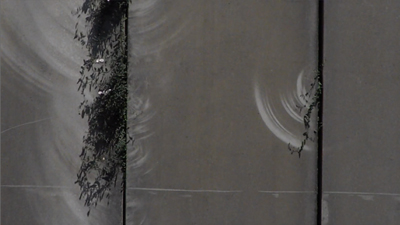
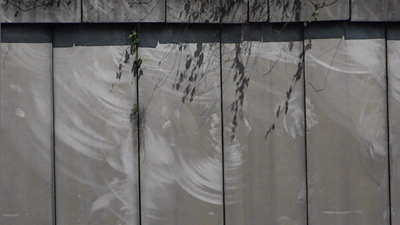
So in “Silent” you have the desperate and mute battle of weeds for existence on the vertical desert which are highway walls. Between the junctions of one block and another, seed find just enough dirt to root and spread some leaves and branches over the crack into the dusty wind where cars speed. The branches whipped by the wind hit the concrete walls that entrap their lives like waves hit the shore, with the traffic direction determining their direction. So the leaves brush the dusty walls, brush the exhausts' dust away, cleaning the concrete and drawing an echo of their existence. Echo that remains even when maintenance men come and cut the branches from the wall, leaving just their drawings in the dust.
Then in “Control” there is the sheer documentation of a pruning. Men deviating, interfering, mutilating the shape and space a tree would happen to conquer. Mutilating it so severely that the biological cycle of the tree mutates so much that it will not perform its annual loss of dead branches, process completely forgotten and unknown to the urban men. So the tree shape is irreversibly severed and will grow as a clumsy mock, harmless and far behind the beauty that would have shown the poverty of the human creation around it.
|
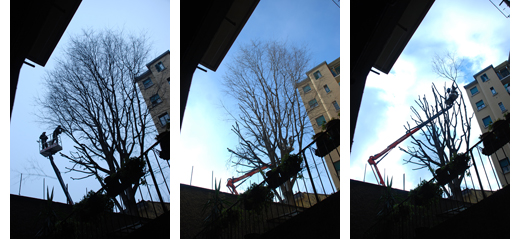 |
"Control" serie of seven lambda prints, 40x26cm, 2010
|
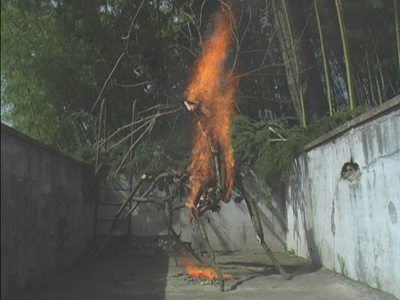
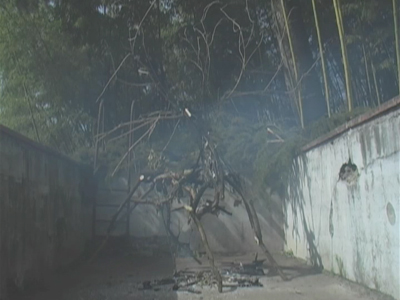
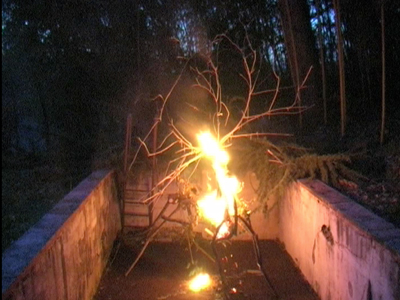
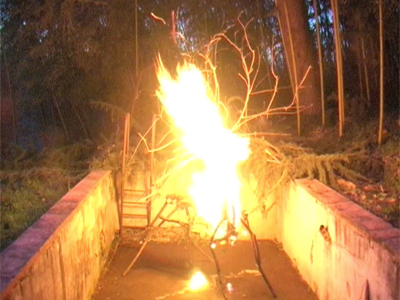
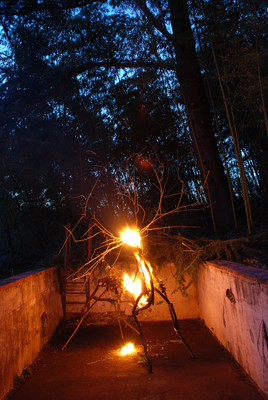
“10.000+” takes some other cut tree branches by human hand and by human hand builds them into a fetish of a wounded forest. In the shape of a tree they burn, in the last attempt to save their home and fellows. They burn to show where they came from and from where they will return, whenever is not given to know. Are the branches of a small wood in Lombardy, on the border with Piemonte, near Milan. A useless road has to be built in a small town for the transit of trucks, in an already highly urbanized area with many alternative roads already working. But the decision is that of cutting anyway one of the last bits of forest left in the area. So a group of artists decide to document all this, documenting their actions in the wood, invited by Serena Porrati and Francesca Tollardo.
 
|
|
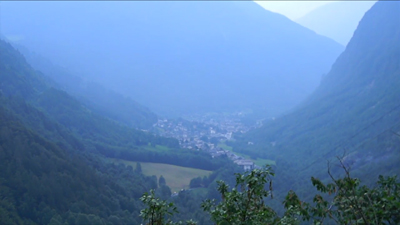
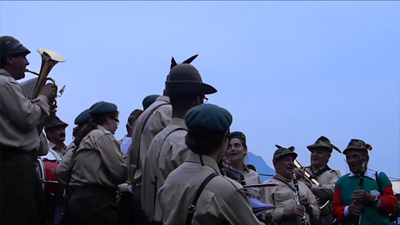
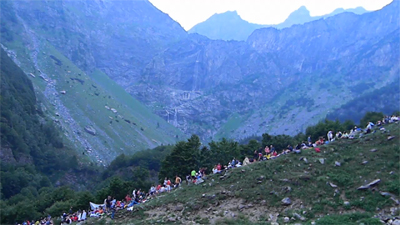
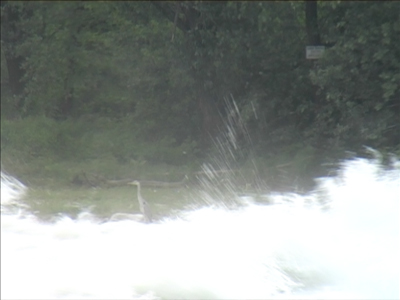
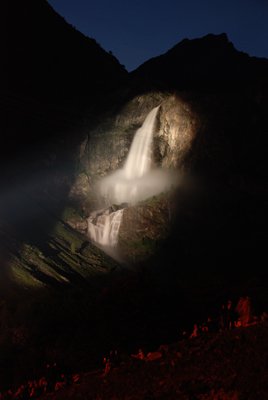
“Exile” documents a mass exodus that happens five times a year. Masses of tourists and sunday hikers disembark in a small town at the base of the alps in the north of Italy. The reason for the gathering is the amazing 315 meters (more than 1000 feet) hi waterfall that stands above a plateau at three hours of mountain paths form the village. Until 1931 the waterfall was visible all the year around, but then a dam and an hydroelectric power plant where built and the waterfall almost disappeared. But five times a year the water from the dam is released in an ecstatic show that attracts the before mentioned hikers. The flow of people is almost touching, as it testifies the crave for sublime in humans, even though the thought it was proper to embellish it with a fanfare, fireworks and culinary stops all along the route. So that the valley becomes the absurd comedy of a sunday mass picnic in a land of majesty, where the peaks stare isolated and jaded, punctured by hi-voltage lines, and the more humble mushrooms wish not to be stomped by the mass. But the water falls back where it is meant to be and everything is just what it is.
|
|
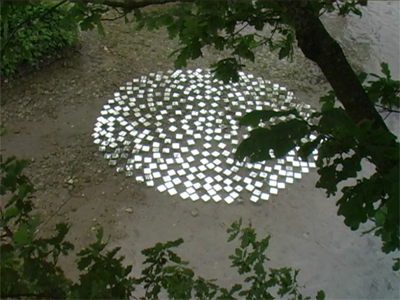
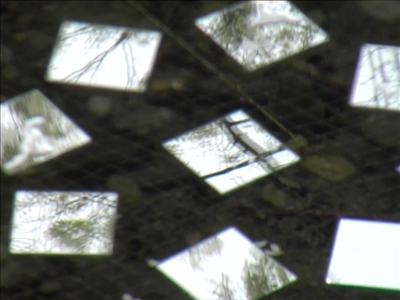
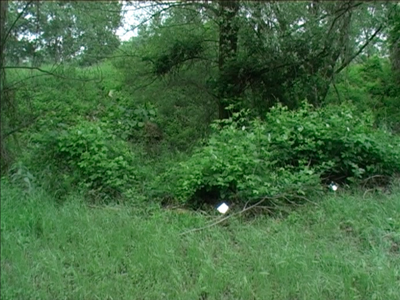
On the other hand “unnamed, unpossessed” isolates water from human interferences and shows its birth and flow. Place and phenomenon that for it's complexity cannot be reduced to a name, as in the garden of Eden story where the act of naming by Adam is an act of possession on nature. But you can possess only what you can rule and even with all the dams and pipes humans can conceive, it is simply not the case. A mirror sculpture placed in a natural spring in the water is the main human sign on the scene and as an ancient menhir is there to show the presence of an important or primordial place, in fact a place from which human's depend, and not the opposite. The sculpture make more visible the movements of the water and the reflected images of the environment in it visualize the bonding between all the phenomenons. And as the water flows away, some mirrors descend the river and merge with the surrounding landscape. Mirroring a landscape we can fortunately be just witnesses and not masters.
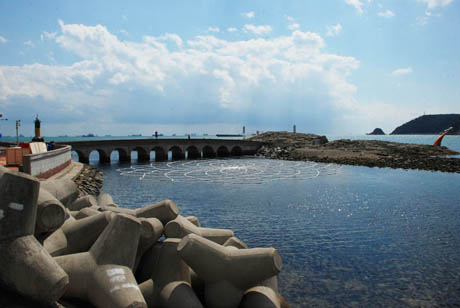
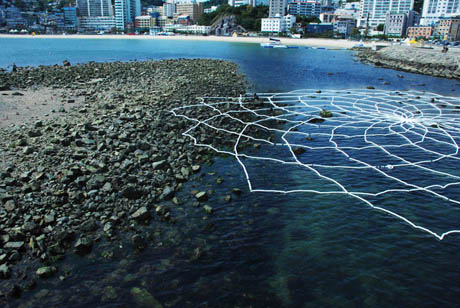
“New Birth, New Star” took the idea of “unnamed, unpossessed” to a larger scale and impact. Being 1600 square metres big (more than 1800 square yards) the work could confront a environment as powerful as the ocean, in Busan, in the south of Republic of Korea. Built for the Busan Biennale Sea Art festival, won the Grand Prize.
Placed in a bay near Songdo Beach, wants to mark the sea as a fundamental element for the city of Busan economy, for Korea identity, and more in general as one of the basic environmental elements needed for the life of the planet. |
 |
 |
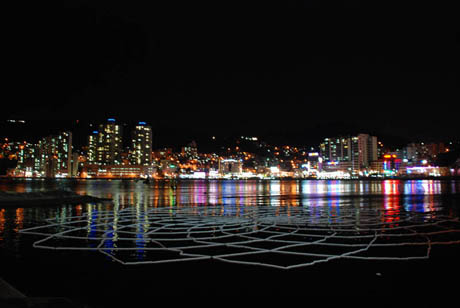 |
"New Birth, New Star", 2011, 40x40m (43x43yds) |
 |
“Fiends” is a photographic serie of four pictures. These were taken in an old dismissed industrial complex which was one of the main producers of concrete Italy as well as in the world. Its history is one century long and is a perfect metaphor of a fairy tale of modernity. Concrete is the symbol of our landscape colonization. Wherever “civilization” reaches, there will be concrete. In this old factory some of the oldest and unreachable tunnels got infiltrated by water, slowly spilling and limestone has sedimented into stalactites and stalagmites as in natural underground caves. Nature claims some land back and paradoxically the new shapes mixed with the old tunnels seem to form monstrous faces, sort of guardian demons protecting the belly of the earth from other excavations.
|
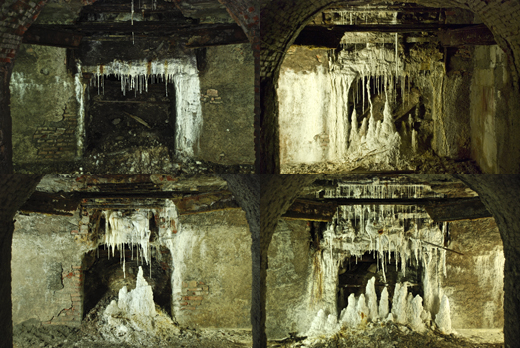 |
| "Fiends", 2010, four lambda prints, 120x80 cm |

|