A few technical investigations. To bring it all back to the basics, dance explores movement, music uses sound and visual arts, well, they pretty much have to do with light, even dough then they can incorporate all the rest. Visual art is based on light because that is the only cause, the material, that made vision to occur. The genesis of it is to me one of the most amazing things. Firsts, as a given state, we have the first of the light properties that we need to know to understand this little explication. Light is white at the origin and contains all the frequencies that singularly would appear as all the different possible colors. Light hits objects around us and due to the properties of the materials it hits, gets partially absorbed and the rest gets reflected. We could say that the color we see is the reflected part. So a red object is so because absorbs all but red radiation, a white one reflects all of them, while a black one none of them. That also explains why a black object in the sun gets very hot while a white one much less, because the black one absorbs so much more energy than the white one from light. Useless to say that shadow forms on the other side because is not hit by the light source and so it remains dark, not reflecting any light, or maybe less coming from another source. So being this the starting situation, organisms are immersed in a world where multiple sources of reflected light reach in contact with them, with their skin.So some of the smartest, or more skin sensitive, of this guys developed some areas that where in fact sensitive to light. It started with a very simple reaction of yes or no “yes, there is light, no there isn't”. So imagine you are a bunch of cells swimming randomly in the sea where life had just developed. Maybe to make the chemical reactions in your tiny body work you need light or maybe you feed of tiny as well algae which grow in the presence of light. In both cases you need to find light to live. If in your random wandering you have an indicator that says “Yes, there is light here” your odd driven life would have much more chances to continue, because you would stop swimming there and enjoy your harvest. While when the light would go away, you would start to swim again until the indicator does tell you to stop again. Pretty simple but pretty effective. But wouldn't it be wonderful if your little sense, would tell you also in which direction you could find light? You would save a lot of time and energy, instead of swimming around hoping to be lucky. Then some clever creatures, had their sensitive areas a little depressed in the skin, like inside the bottom of little cups. What was the advantage of this? Exactly the one we hoped. The light hitting a depression projects both a light, as well as a shadow, which is dependent from the direction of the light source. So in little brain of our swimming fellows was able to determine from where the light was coming and move in that direction without having to guess. And now we need to point out the second and last of the light properties that we need for this little investigation. When light gets to a hollow space passing through a hole, projects the image of the outside, upside down inside the hollow space. This is something we all learned at the elementary school and its exactly what we need to understand, as we are speaking about eyes. So what happened is that the little depressed areas on the skin of the little creatures, got deeper and deeper, and their entrance got narrower. Being so, the light was at first projecting inside more precisely and then started to form images. So the creatures started to develop more complex sensitive areas. First to different shades, then to different colors. And at the same time their brains got more complex, to elaborate these informations into the image of the world. And from here the history of visual arts begins. One interesting consequence of what described until now is that it has become in modern times the theory upon which basing the invention of photography. The principle of light projecting the image of the outside world upside down into an hollow space through a hole was certainly known already at the greeks and probably also before. It is believed from some researchers that it could be at the origin of Plato's cave myth. So it wasn't hard to build places or machines exploiting this property and use them in different ways, to entertain or as first sketch for paintings. What was missing was a way to fix the projection over a surface to obtain what we know now as photography. That chance came in1826 and thanks to the development of chemistry since then we then had a multitude of processes, leading to modern films and prints. Digital photography changed the way to capture the image in the camera, but not the basic principle. Being aware of this I wanted to explore these possibilities, as they where the key to explore visual arts from a technical point of view.
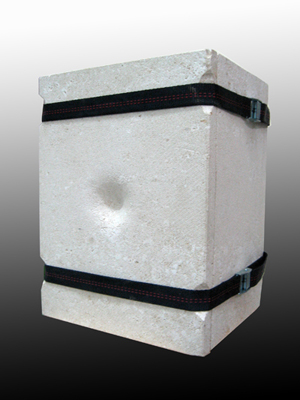
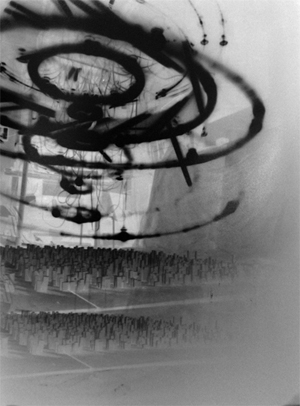
“Stone”. The first attempt of doing so was testing these premises in a more radical way, not just going back to the simplest pinhole camera, but straight back to the Cave myth. I was looking for the primordial possibility for the image to be. I was looking for the original wonder. “Stone” in a perfectly working pinhole camera carved from a single stone block. It has a 0.25mm pinhole and can capture very detailed images. That's the rawest I could go.
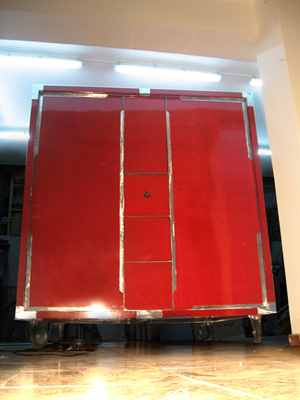
With “Lucifer” on the other hand, I wanted to experience and explore the creation of images from the inside. Being inside an eye, inside a camera. So I built a 2x2x2 meters room on wheels.
|